 Agency Statistical Consulting
I've had a peanut butter and jelly sandwich for lunch almost every day for the past 40 years. It made for an easy, portable, non-perishable meal during those long residency days (and nights). It's become my trademark. At my retirement party, everyone in my health department brought me a jar of either peanut butter or jelly. I gave a bunch to our local food bank and still had many months' worth of sandwich fixins'.
Being frugal---OK, let's be honest, a cheapskate---I am always on the lookout for the best deal on bread. It's not that straightforward. We all know that the price tag on the loaf may not be the most important thing. Much depends on how much the loaf weighs. For years now, grocery stores have posted the "unit price"---the cost per pound. "Pound" here is the denominator. But is it the right denominator? Few people make their sandwiches by the pound. I don't weigh my bread. I just pull out two slices and make a sandwich. What I really care about is how many sandwiches I can get from a loaf, which is the same as asking what's the cost per sandwich. So the denominator that really matters is "the sandwich" or "the pair of slices."
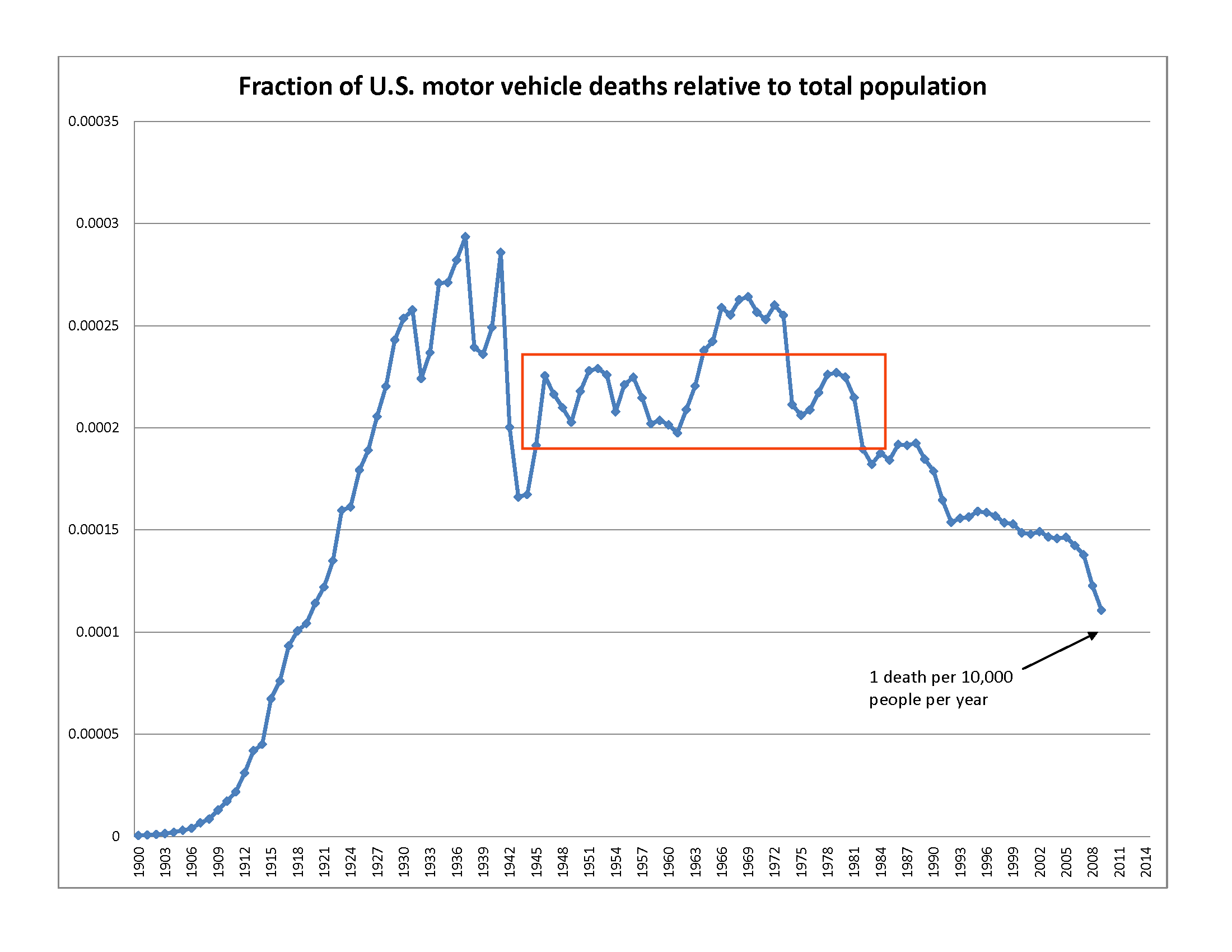
Denominators are important in epidemiology too. The graph below, from from Wikipedia (https://en.wikipedia.org/wiki/List_of_motor_vehicle_deaths_in_U.S._by_year) shows the trend in annual motor vehicle fatalities in the US, from 1900 to around 2008. Notice the period from around 1950 to around 1980 (in the orange box). On average, ot much net change. But also notice the denominator---the "per". It's "deaths per 10,000 people." This is not the best choice of denominator for these data. A person can only die in a motor vehicle crash if they are in a motor vehicle, or struck by one. The act of driving/riding, or being near motor vehicles, is the exposure. The more vehicles, and the more they drive, the greater the exposure. The denominator of "per 10,000 people" doesn't take into consideration the number of vehicles on the road and the number of miles they are driven---both of which surely increased between 1950 and 1980.
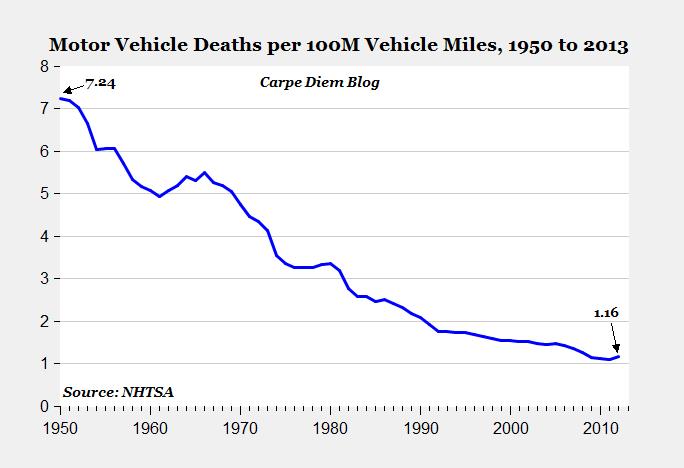
A better denominator for this issue, and the one that is commonly used in the field of traffic safety epidemiology, is "per million vehicle-miles driven." To understand that, think of one million vehicles each driving one mile---that's one million vehicle miles. Or think of 100 vehicles each driving 10,000 miles---that's also one millon vehicle miles. The graph below shows the annual number of deaths from motor vehicle crashes per 100 million vehicle-miles. Here you can see that between 1950 and 1980, if we factor in the amount of driving going on by using the better denominator, things actually got a lot better, with the death rate decreasing by a lot.
Epidemiologists and statisticians do a lot of counting. Most often, we count the number of something per something else---some unit of time, space, population, or exposure. It's very important to always be aware of what unit is being used for the denominator. That's the only way you can properly interpet the counts.
OK, I exaggerated. I haven't eaten a PBJ sandwich for lunch every day for the past 40 years. During the darkest days of the COVID-19 pandemic, I switched to peanut butter and honey, because it was quicker to make. Compared to scooping out and spreading jelly, squirting some honey from the squeeze bottle onto the sandwich saved me about 45 seconds each evening as I prepared things for the next day. And since I was working all evening too, those 45 seconds mattered. A statistician friend of mine would even ask me once in a while what I was having for lunch. Peanut butter and honey---things were bad and she was more worried. Peanut butter and jelly---incidence rates were slowing and she could relax a bit.